
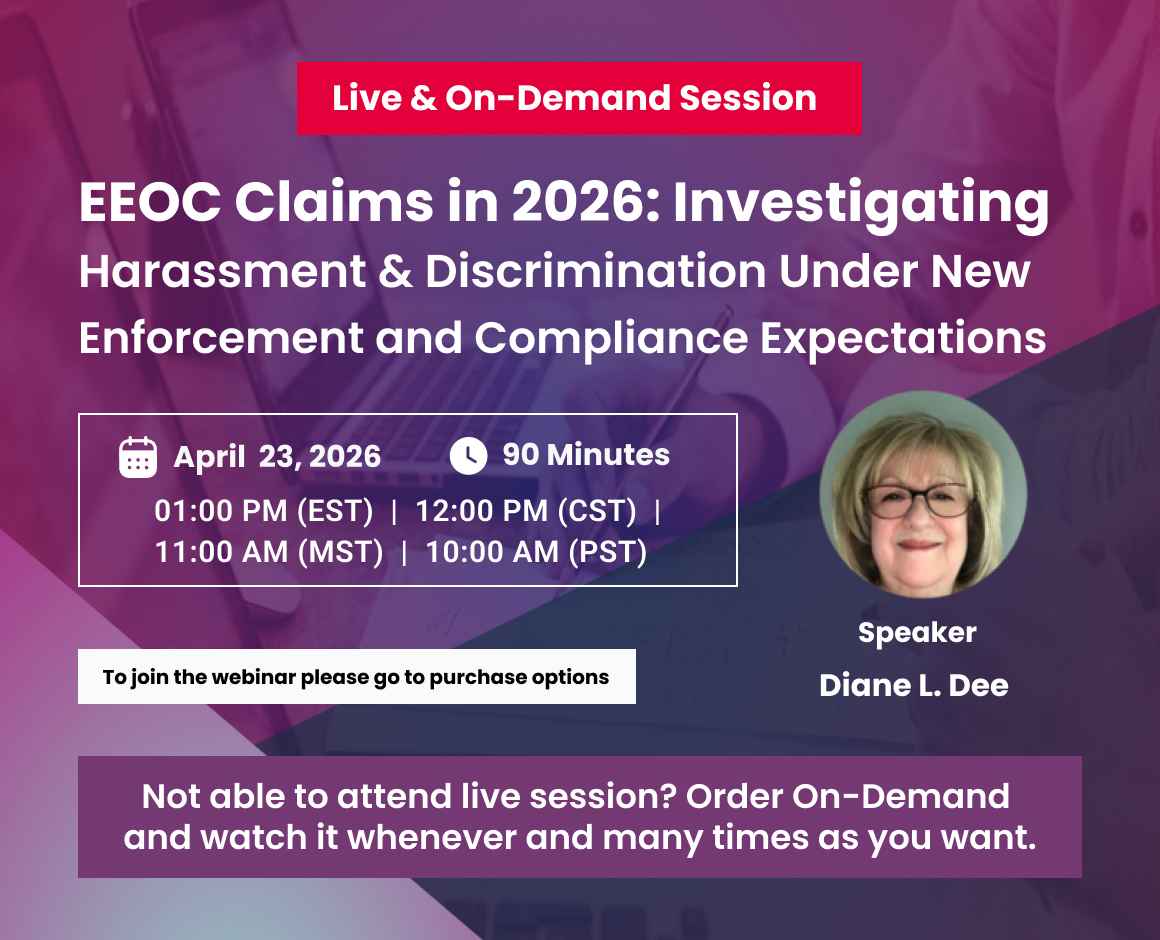
Overview:
On January 22, 2026, the U.S. Equal Employment Opportunity Commission (EEOC) voted to rescind its Enforcement Guidance on Harassment in the Workplace. This is one of the first acts the EEOC has taken since it achieved a quorum in October 2025.
The U.S. Equal Employment Opportunity Commission (EEOC) rescinded its 2024 harassment guidance in early 2026, an action that reflects shifting federal enforcement priorities. The EEOC's action does not alter an employer’s obligations to maintain harassment free workplaces under federal anti-discrimination laws. However, the rescission draws into question an employer’s obligations with respect to prohibiting harassment based on an individual’s gender identity.
EEOC harassment and discrimination claims continue to be a top compliance and litigation risk for U.S. employers. In 2026, organizations face expanded enforcement priorities, increased scrutiny of employer investigation practices, and heightened expectations for documentation, reporting, and workforce data transparency—shaped in part by federal workforce initiatives connected to the One Big Beautiful Act (OBBA).
In this timely and practical session, Ms. Diane L. Dee will guide employers through how to properly respond to EEOC charges, manage internal investigations, and align workplace practices with 2026 EEOC procedures and compliance expectations. The program will also address the role of key EEOC forms and employer submissions, including updated digital charge management and employer response processes now used by the agency.
Attendees will leave with a clear, step-by-step understanding of how to conduct legally defensible investigations, prepare accurate employer responses, and remain audit-ready in an increasingly data-driven enforcement environment.
Why Should You Attend:
- Understand how 2026 EEOC enforcement priorities and investigation standards affect your organization’s risk and response strategy
- Learn how employer documentation, reporting, and data practices are being influenced by workforce accountability measures associated with the One Big Beautiful Act (OBBA)
- Gain clarity on how to properly manage EEOC forms, employer submissions, and digital charge-handling systems in 2026
- Reduce exposure to retaliation, procedural errors, and inconsistent investigations
- Strengthen your organization’s ability to respond confidently to EEOC audits, charges, and information requests
Session Highlights – 2026 Compliance & Investigation Focus:
- 2026 EEOC enforcement priorities and systemic discrimination initiatives impacting employer investigations
- Updated 2026 harassment and discrimination standards, including evolving interpretations of protected classes and intersectional claims
- EEOC Charge of Discrimination (Form 5) – 2026 employer response expectations and documentation requirements
- Notice of Charge and Requests for Information (RFI) – 2026 digital submission and employer portal process updates
- Employer position statements and supporting evidence – 2026 formatting, confidentiality, and consistency best practices
- EEO-1 Component 1 workforce data reporting – 2026 filing considerations and how workforce data is used in discrimination investigations
- Record retention, investigation files, and audit readiness standards for 2026, including expectations influenced by the One Big Beautiful Act (OBBA) workforce accountability initiatives
- Remote and hybrid workplace misconduct investigations – 2026 compliance risks and practical investigation techniques
- Investigator independence, neutrality, and credibility standards – 2026 best-practice framework
- Manager and supervisor reporting obligations under the 2026 employer liability standards
- Preparing for EEOC audits, subpoenas, mediation, and expanded information requests in 2026
Who Should Attend:
- HR Directors, HR Managers, and HR Business Partners
- Compliance, Risk, and Governance leaders
- Managers and supervisors involved in complaint handling and investigations
Conclusion:
Stay ahead of 2026 EEOC enforcement trends, improve your investigation process, and ensure your organization is ready for evolving compliance standards influenced by the One Big Beautiful Act (OBBA) and today’s rapidly changing workplace environment.

